
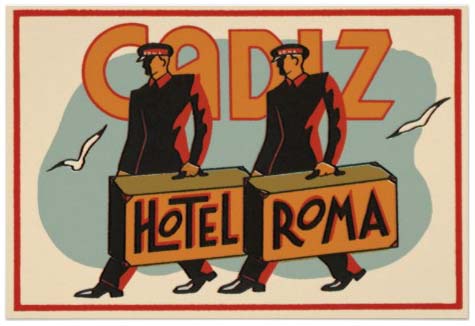
 Earlier this year, I discovered the fantastic book ‘World Tour’ by Francisca Matteoli, which documents the ‘golden age’ of travel and exhibits a wonderful array of luggage labels which were collected in this era by the grandson of Louis Vuitton. I was so fascinated with this voyage of discovery into the ‘Belle Epoque’ that I had to ask the author more about the book. I hope you enjoy our Q&A as much as I did.
It feels like you put your heart & soul into this amazing book. Was it a labour of love? And what part of the project did you enjoy the most?
I am Chilean, my mother is Scottish, I lived in Brasil, I am now living in Paris… I wanted to write about all the coutries that are important for me, evoque emotions, get the readers involved, and tell stories. That is what I like to do. In my book I developed all these aspects in 21 different travel stories. It was very exciting and fun. I had to do a lot of research, which I adore. I wrote on my great-grandfather and on my family which also lived in hotels, imagined how their life was and the one of Gaston-Louis Vuitton, that was inspired by anecdotes and memories I had in a corner of my mind. The challenge was to write a book that had never been done before because so much has already been said about hotels, but so little about personal and human experiences of that golden age of travel. Gaston Louis Vuitton reminded me of members of my family, such as a distant uncle or cousin. I found inspiration in a million details and really wanted to share all of the fantastic memories I had, and the spirit of adventure that existed at another time. I enjoyed every minute of it.

The book contains an incredible range of beautiful labels. Has this great tradition disappeared from hotels completely?
Yes, unfortunatly, and I don’t think you can find anything today that can replace the labels of that time. First because nowadays things are not made to last. We don’t know how we are going to live in 5 years from now, but I still have my parents travel albums and the labels they used to attach to their suitcases. It is the duration that also makes these luggage labels so beautiful and fascinating. They still exist centuries later. They made it across time, keeping their elegance and dream. You don’t find those labels in hotels anymore because the world changed completely.
Luggage labels seemed very important back then. Was there any kind of competition between hotels & places to create the finest labels?
Of course. They all wanted to create works of art !

I think the most stunning collection of labels in the book are those from Paris. Was the city at the centre of the Belle Epoque?
Yes, those labels are from a period characterized by optimism and peace in Europe. Paris was decadent, beautiful, with the building of the Eiffel Tower, the Opéra Garnier, the Gare d’Orsay, the Grand Palais, the grand hotels… There was a desire of new and extraordinary things…
You cover a lot of the world in your book. Were there many places you didn’t have room for?
Yes, I had to make a selection and it was totally subjective. I decided to write on the labels which inspired me most. I also wanted to be able to tell stories. As all South Americains, I adore telling stories. And writing stories. My favorite hotel labels bring back many personal memories such as the Hotel Gloria in Rio de Janeiro for example, because I lived in Rio and because it’s situated in one of the most legendary cities of the world. I also like very much the label of the Hotel Le Meurice in Paris because it epitomises for me French elegance of a city I love. The label of The Grand Hotel d’Angkor is another of my favorite. It’s more a painting than a label… I wanted to bring an emotion when you look at them and make you think “I’d love to be there, to see that place”.Maybe I would make an other book with those whom I forgot this time… There is still a lot but I keep the secret !

You mention that the style of the labels was inspired by Japanese minimalism. Does this include any artists in particular?
In fact there are different styles according to different periods. And very different artists too, such as the Italian Mario Borgoni. He studied at the Napolitan Art Institute and his hotel labels were like posters. There was also the Austrian Franz Lenhart, very active during the late 20s, the Italian Filippo Romoli who designed many hotel labels like the one of Hotel Des Bains and many others…
Was the golden age of travel as glamourous as it appeared?
Well, that’s an excellent question. My family knew the golden age of travel, the steamer-trunks, the luxury liners, an age of elegance, but their lives and travels were also marked by the emigration, the loss, the risk, the unknown. The golden age of travel is also all that. It was epic, tragic, crazy – like the travel I did with my family to come to France. When we think “Golden Age of Travel”, we think mostly of the glamour and the luxury but it was much more than that. It was an age of hopes and dreams, of adventures, changes, people settling into a new countries…A time when everything could arrive.
Finally, I can’t wait to read the rest of your travel-inspired books. What you do love about travelling the most?
Telling stories. And also going back to my roots because my heritage has been determinant in my life choices and in my writing. Writing was always a refuge for me, especially when we left Chile. I love the fact that I can write about extremely different places and experiences. I wrote for National Geographic – about Rwanda, for example. Several years ago, I joined the French Doctor where my husband was working as a surgeon. He is a plastic surgeon who also does reparatory and reconstructive surgery. It’s a totally different experience of course than to write about hotels or glamourous destinations, but I try to keep an open mind and I think that the entertainment which a lighter book can bring also has an influence that can be as strong on somebody as the description of a more sensitive issue. Our world is complex and I like the idea that people who read my work are also complex and can be touched by any kind of subject. I learned a lot by working for National Geographic and going on humanitarian missions, but also by trying to be lighter and enjoy life. When you travel, you learn to adapt yourself, you learn that you must be prepared for all kind of things, and that there are no certainties. You see life in a different way. All those aspects are very important to me. That is what I love the most about travelling.
 Cloves are one of a number of exciting spices which feature in our fragrant